

Match Winner vs Double Chance Betting Strategy
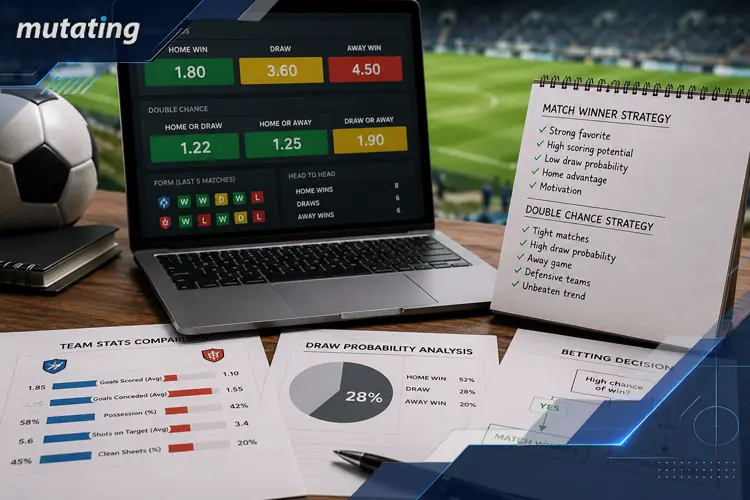
Match winner and double chance are two of the most important markets in football betting, but they should never be used in the same way. The match winner market asks for one exact result: home win, draw or away win. Double chance gives more protection because it covers 2 possible outcomes in a single selection. That difference changes the risk, the odds, the type of analysis required and the way a bettor should manage each prediction.
A good betting strategy is not about always choosing the safest option or always chasing the highest price. It is about understanding which market fits the match better. Some fixtures justify a direct match winner selection because one team has a clear advantage. Other fixtures are more suitable for double chance because a team looks unlikely to lose, but the draw remains a realistic possibility. Knowing when to use each market can make football predictions more logical, more disciplined and more professional.
What The Match Winner Market Really Means
The match winner market is the classic 1X2 football betting option. There are 3 possible outcomes: the home team wins, the match ends in a draw, or the away team wins. To win this type of selection, the chosen outcome must happen exactly. If the home team is selected and the match finishes level, the bet loses, even if the home side dominated possession, created more chances or looked like the better team.
This is why match winner betting carries more risk than many beginners expect. Football is a low scoring sport, and small moments can change the final result. A missed penalty, a red card, a late equaliser, an own goal or a goalkeeper mistake can turn a strong prediction into a losing one. The match winner market can be profitable, but it demands clear evidence that one outcome is more likely than the other 2.
The main attraction is that match winner odds are usually higher than double chance odds. Since the bettor is choosing only 1 outcome from 3, the possible return is normally better. This makes the market useful when the analysis strongly supports one team and the draw risk appears limited.
What Double Chance Adds To A Betting Strategy
Double chance is designed to reduce risk by covering 2 outcomes instead of 1. The most common options are home win or draw, away win or draw, and home win or away win. These are often shown as 1X, X2 and 12. The selection loses only if the uncovered result happens.
For example, if a bettor chooses home win or draw, the bet wins if the home team wins or if the match ends level. It only loses if the away team wins. This makes double chance useful when the main idea is that a team should avoid defeat, rather than definitely win.
The trade off is lower odds. Because double chance gives more protection, bookmakers reduce the price. This means double chance is not automatically a better strategy. A low risk selection can still be poor value if the odds are too short. The purpose of double chance should be to match the real profile of the game, not to create a false sense of safety.
The Core Difference Is Precision Versus Protection
The difference between match winner and double chance can be reduced to one idea: precision versus protection. Match winner requires a precise prediction and rewards that risk with better odds. Double chance gives protection against one possible outcome, but the reward is smaller.
Neither market is superior in every situation. Match winner is stronger when one team has a clear edge and the match context supports a decisive result. Double chance is stronger when a team has enough quality to avoid defeat, but the match contains a serious draw risk.
This is where many bettors make mistakes. Some choose match winner because the odds look more attractive, even when the match is balanced. Others choose double chance because it feels safer, even when the price is too low to justify the risk. A professional approach starts with the match profile and only then chooses the market.
When Match Winner Is The Better Option
Match winner can be the better strategy when several indicators point toward one team winning. A strong home favourite against a weak away side is the most obvious example, but the analysis should go deeper than reputation or league position.
Good match winner candidates usually have consistent scoring numbers, strong defensive control, positive recent form and a clear tactical advantage. They often create more chances than opponents, score first regularly and manage leads well. If the opposing team struggles to score, concedes often and performs poorly in similar fixtures, the case for match winner becomes stronger.
Motivation also matters. A team fighting for the title, promotion, European qualification or survival may have a strong reason to push for 3 points. If the opponent is already safe, out of form or dealing with injuries, the direct win option may become more attractive.
Still, the draw should never be ignored. Even strong teams draw matches. Before choosing match winner, ask whether the favourite has enough attacking power to break the opponent down and enough defensive reliability to avoid giving away an equaliser.
When Double Chance Makes More Sense
Double chance is often the smarter choice when the selected team has strong qualities but the match is not clear enough for a direct win prediction. This is common in away fixtures, derbies, matches between similar level teams, tactical games and fixtures where the draw is a realistic result.
For example, a strong away team may have better players and better recent form, but the home side may be compact, difficult to beat and strong in its own stadium. In that case, away win or draw may be more logical than away win. The selection still supports the better team, but it respects the possibility of a tight match.
Double chance can also work well when a team has a strong unbeaten pattern. Some teams do not win every week, but they are hard to beat because they defend well, control tempo and avoid major mistakes. This type of team can be suitable for 1X or X2, depending on the fixture.
Using Data To Choose Between The Two Markets
Good betting decisions should be based on evidence. Before choosing match winner or double chance, compare recent form, goals scored, goals conceded, clean sheets, home and away records, draw frequency and opponent quality. These numbers help show whether a team has a real winning edge or simply a good chance of avoiding defeat.
Detailed football stats can help identify patterns that are not obvious from the league table alone. A team may be high in the standings but winning by narrow margins, conceding regularly and depending on late goals. Another team may be lower in the table but have solid home form, strong defensive numbers and better underlying performance than results suggest.
The key is to connect the data to the market. If one team scores consistently, concedes very little and faces an opponent with poor attacking output, match winner may be suitable. If one team is solid but not dominant, and the opponent has enough quality to force a draw, double chance may be the better choice.
Why Draw Probability Is The Deciding Factor
The draw is often the most important factor when comparing match winner and double chance. A match winner selection loses if the game finishes level. A double chance selection can survive the draw if the chosen option includes it.
Some matches naturally carry higher draw potential. These include fixtures between evenly matched teams, games involving defensive sides, matches with low scoring trends and situations where a point may suit one or both teams. In these cases, double chance can be more appropriate because it protects against a very realistic outcome.
Low draw probability usually appears when one team is clearly stronger, when the weaker side concedes frequently, when the favourite has high scoring consistency, or when the match context demands a win. In these situations, the match winner market may offer better value because the draw is less central to the analysis.
Home Advantage And Away Resilience
Home advantage remains important in football betting. Some teams play with more aggression, confidence and attacking volume at home. They press higher, create more chances and control the rhythm better in familiar surroundings. If the home team also has strong defensive numbers, match winner may become attractive.
Away resilience is different. Some teams are difficult to beat away from home without necessarily being frequent winners. They defend compactly, manage pressure well and use counter attacks effectively. These teams may not always justify an away win selection, but they can be strong candidates for away win or draw.
This is why venue based analysis is essential. Overall season numbers can be misleading if they hide major differences between home and away performance. Always analyse the home team at home and the away team away before choosing between match winner and double chance.
Common Mistakes Beginners Should Avoid
One common mistake is backing a match winner only because the team is famous or higher in the table. Big clubs still draw and lose matches, especially away from home, during busy schedules or against tactically difficult opponents. Reputation can influence public opinion, but it should not replace analysis.
Another mistake is using double chance as a safety button. Double chance reduces risk, but it also reduces odds. If the price is too low, the selection may not be worth taking. A bet that wins often can still be weak if the return does not match the real probability.
Beginners also make the mistake of changing market because of fear. If the evidence strongly supports a team win and the odds are fair, moving to double chance may remove too much value. If the evidence shows a serious draw risk, forcing a match winner selection may be too aggressive. The market should always match the analysis.
A Practical Strategy For Match Winner And Double Chance
A simple method can make this decision easier. First, check whether one team has a clear quality advantage. Then analyse goals scored, goals conceded, home and away form, recent results and injury news. After that, assess the draw risk. If the favourite has strong indicators and the draw appears unlikely, match winner may be the right option.
If the selected team looks strong but the game appears tight, double chance may be smarter. This is especially true when the opponent is well organised, the match is away from home, or both teams have a history of low scoring results. The goal is not to avoid risk completely, but to choose the risk level that fits the fixture.
The final step is to compare the odds with the probability. A direct win may be better when the price is fair and the winning edge is clear. Double chance may be better when protection is valuable and the odds still offer reasonable return.
Bringing The Analysis Together
Match winner and double chance are both useful football betting markets, but they should be used in different situations. Match winner suits clearer edges, stronger favourites and fixtures where the draw risk is limited. Double chance suits balanced matches, cautious strategies and situations where a team looks unlikely to lose but not certain to win.
The best approach is flexible. A serious bettor does not choose one market for every match. Instead, each fixture should be analysed on its own merits. By studying team performance, home and away records, goal trends, defensive strength and draw probability, it becomes easier to decide whether the better option is a direct winner or a protected outcome.
In the long run, strong market selection is just as important as choosing the right team. A prediction becomes more professional when the chosen market reflects the evidence. That is the real difference between betting on instinct and building a disciplined football betting strategy.